Artificial Intelligence Laboratory
Heads of the Research Group: Dr. Anna GELENCSÉR-HORVÁTH, Dr. Kristóf KARACS
Members of the Research Group: Arnold ARADI, Gergely DINYA, Dorka Boglárka ERŐS, Péter HALÁSZ, Márton Menyhért JUSZTIN, Viktor KARACS, Márk PÉTER
Contact: gha@itk.ppke.hu, karacs@itk.ppke.hu
Our research focuses on computer vision and 4D scene understanding for object and structure recognition, mapping, and navigation, while designing these processes to be fast, resource-efficient, and modular. A core part of our work is how task-dependent or general scene understanding can be achieved with low computational requirements, using only a single handheld phone camera and depth sensor . The aim is to perform planning and mapping of the environment simultaneously on an arbitrarily long video stream in dynamic scenes. We integrate our research results into the framework of our LetSee application, which was developed for visually impaired users and provides, for example, audio feedback for complex tasks such as route following, object localization, and interaction with objects. At the 2024 Cybathlon, in the vision assistance (VIS) race for technologies supporting visually impaired people, our team, EyeRider, achieved an outstanding first-place result. Our visually impaired pilot completed the tasks independently, using only a single mobile phone with no network connection. This demonstrated, in a live, real-world setting, that a portable, resource-constrained solution can not only be competitive but can also outperform more complex, heavyweight systems.
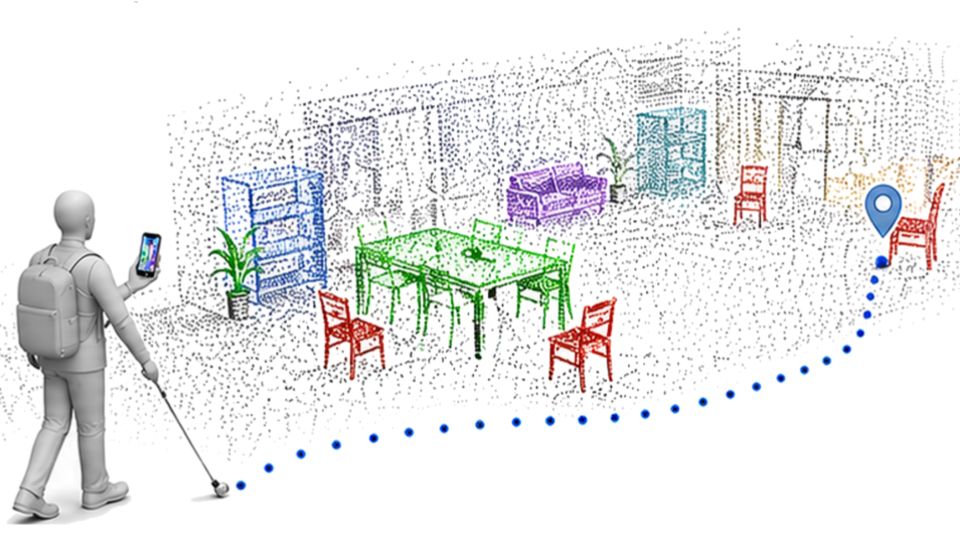
Overall concept of 4D scene understanding, mapping, and navigation in dynamic environments for the visually impaired. We develop algorithms that operate under limited computational resources, using only a handheld camera and depth sensor.
Future research directions, collaboration opportunities
Our group offers professional and research collaboration in computer vision, 3D/4D scene understanding, semantic mapping, and real-time, resource-efficient AI systems. We focus on application-oriented assistive technologies and contribute through method development, validation, joint publications, and proposal preparation.
Key publications
- Gelencsér-Horváth, A., Dinya, G., Halász, P., Erős, D., Muqsit, I. M., Karacs, K. (2026). SceneVGGT: VGGT-based online 3D semantic SLAM for indoor scene understanding and navigation. IEEE INTERNATIONAL CONFERENCE ON IMAGE PROCESSING
- Dinya, G., Gelencsér, A., Kupán, K., Küpper, C., Karacs, K., Gelencsér-Horváth, A. (2026). SAMannot: A Memory-Efficient, Local, Open-Source Framework for Interactive Video Instance Segmentation Based on SAM2. JOURNAL OF OPEN RESEARCH SOFTWARE
- Gelencsér-Horváth, A., Németh, J., Karacs, K. (2026). Bringing Mobile Computer Vision to Visually Impaired People: Designing a Versatile Phone-Based AI Assistant. MOBILITY OF VISUALLY IMPAIRED PEOPLE, SPRINGER NATURE SWITZERLAND